


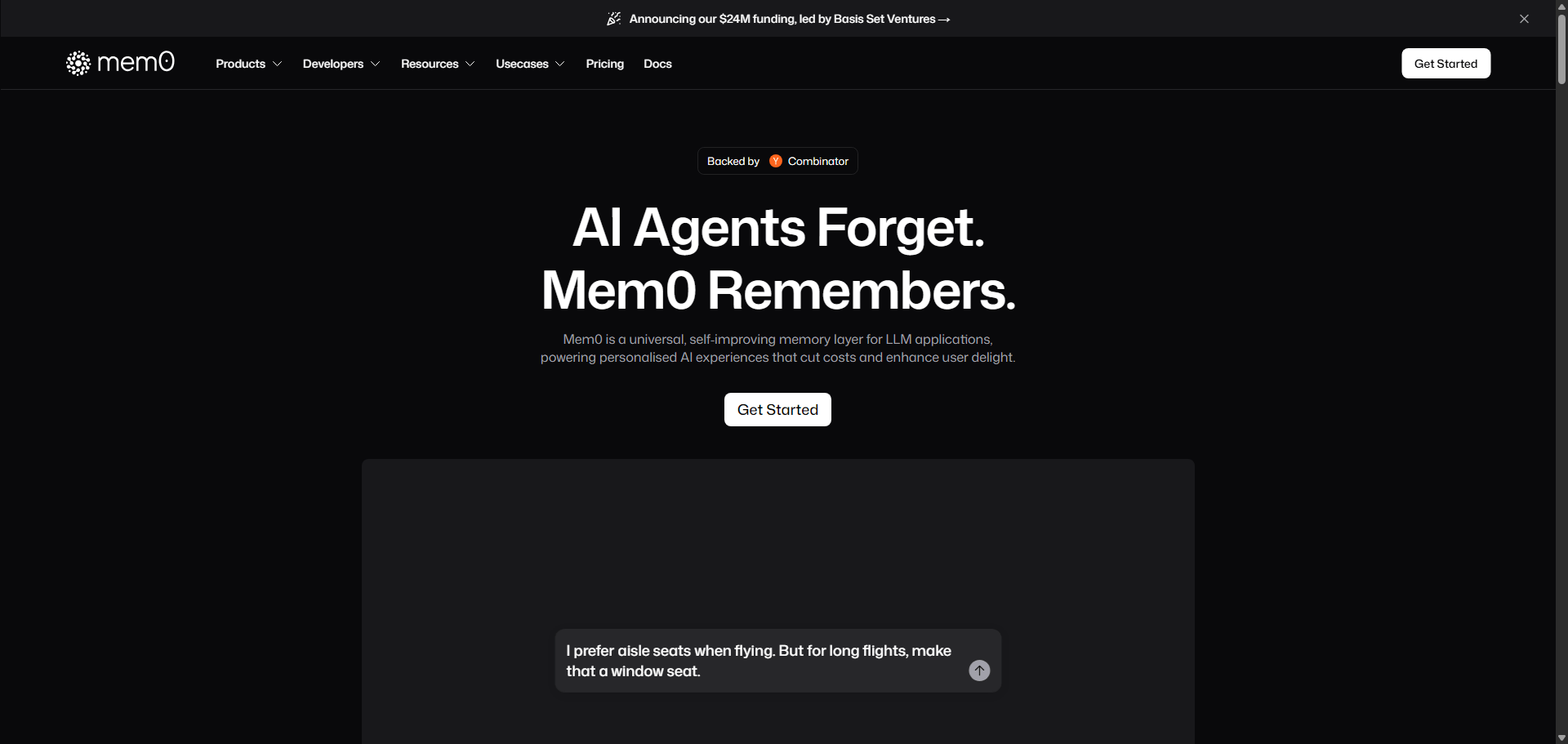
Universal memory layer for AI agents that enables persistent context, massive token savings and long-term personalization across sessions.
Mem0 is a cutting-edge memory infrastructure designed to give AI agents long-term recall, context persistence, and personalization. Unlike typical stateless agents that “forget” after each session, Mem0 supplies a “memory brain” for agents that lets them remember user preferences, past interactions, and evolving knowledge — improving relevance and reducing token-usage over time. (mem0.ai)
Built for developers and enterprises alike, Mem0 supports major LLM ecosystems (OpenAI, local models, LangGraph, CrewAI etc). It offers a low-friction install and promises major token savings, faster responses, and improved agent consistency across sessions. (arXiv)
In short: if your agent platform feels forgetful, inconsistent, or inefficient — Mem0 aims to be the layer that fixes all of that.
| Plan | Description | Price |
|---|---|---|
| Free / Open Source SDK | Full memory infrastructure, self-hosted or dev use | $0 |
| Growth/Team | Hosted platform, memory analytics, more quota | Undisclosed |
| Enterprise | Private cloud/on-prem, full audit/traceability/enterprise SLA | Custom quote |
💡 Mem0’s open-source SDK lets you get started at zero cost. For scale, enterprise features are custom priced.
| Platform | Focus | Pricing |
|---|---|---|
| Mem0 | Universal memory layer for AI agents | Free / Tier |
| Zep | AI embedding + memory infrastructure | Free / Paid |
| Vespa | Vector store + retrieval system | Free / Paid |
| Feature | Mem0 | Zep | Vespa |
|---|---|---|---|
| Core role | Memory layer | Memory & embedding | Vector DB retrieval |
| Token / latency savings | ✅ Up to ~90% | ⚠️ Lower claims | ⚠️ Retrieval focus |
| Developer friendliness | ⭐ High | ⭐ Medium | ⭐ Technical |
| Hosting flexibility | ✅ On-prem + cloud | ✅ Cloud primarily | ✅ Multi-mode |
| Best For | Agent-based apps | Chatbots + agents | Retrieval workflows |
Mem0 stands out as one of the most important building blocks today for next-gen AI agents.
If you’re building agents that need to remember, adapt, and deliver long-term value — Mem0 should be high on your list.
For BestAIAgents.io readers — especially those evaluating frameworks like LangGraph, CrewAI, AutoGPT — Mem0 adds the memory layer that turns “agents” into persistent workflows.
⭐ Overall Rating: 4.9 / 5
Q1. Can I use Mem0 with any LLM?
Yes — Mem0 supports OpenAI, local LLM models, and integrates with major stacks. (Microsoft GitHub)
Q2. Is Mem0 free?
Yes — the open source SDK is free. Hosted tiers cost depending on scale.
Q3. Does Mem0 reduce token usage?
Yes — according to internal benchmarks it can cut prompt/context tokens by up to ~90%. (arXiv)
Q4. Who should use Mem0?
Suitable for developers, startups, agent-builders, and enterprises needing long-term memory in AI workflows.
| Category | Rating |
|---|---|
| Ease of Use | ⭐ 4.6 |
| Features | ⭐ 4.9 |
| Developer Value | ⭐ 5.0 |
| Scalability | ⭐ 4.8 |
| Value for Money | ⭐ 4.7 |
| Overall | ⭐ 4.9 / |